| タイトル |
Brachyspira (Serpulina)感染による反芻動物腸管スピロヘータ症の診断 |
| 担当機関 |
家畜衛生試験場 |
| 研究期間 |
1999~2000 |
| 研究担当者 |
|
| 発行年度 |
2000 |
| 要約 |
Brachyspira (Serpulina)に属する腸管スピロヘータが野生エゾシカ(Cervus nippon yesoensis)に大腸炎をひき起こすこと、ならびにこの腸管スピロヘータ症がすでに日本の野生エゾシカの間で拡がっていることが示唆された。
|
| 要約(英語) |
Seven adult free-ranging sika deer (Cervus nippon yesoensis) were examined using histology, immunohistochemistry and electron microscopy for intestinal spirochetal infection. Histologically, epithelial and goblet cell hyperplasia and edema of the lamina propria mucosa with macrophage and lymphocyte infiltration were observed in the cecum and colon in 6 of the 7 deer. Numerous argyrophilic spirochetes were present in the crypts and some had invaded the epithelial and goblet cells and caused degeneration. Immunohistochemically the organisms stained positively with polyclonal antisera against Brachyspira (Serpulina) hyodysenteriae and B. pilosicoli. Ultrastructurally they were 6-14 µm long, 0.2-0.3 µm wide and had 4-6 coils and 13 axial filaments per cell; such features are very similar to those of the Brachyspira species. These results showed that the spirochetes were capable of inducing enteritis in deer and this intestinal spirochete infection might already be prevalent among wild sika deer in Japan. There is a possibility that this spirochetal colitis is a new syndrome in sika deer and that the same and/or similar spirochetes have infected other ruminants, including cattle. (Comparative Pathology Section, Hokkaido Research Station, TEL +81-11-851-5226)
|
| 背景・ねらい |
近年、我々はBrachyspira (Serpulina)に属する腸管スピロヘータがウシの赤痢に関与することを報告し、反芻動物の消化器障害において腸管スピロヘータの重要性を示唆した。しかしながら、その感染経路、体内分布および病原性に関する報告はない。また、我々が報告した腸管スピロヘータ症罹患例を含め、放牧中のウシは野生動物と接触する機会が多い。そこで本研究では、野生エゾシカにおける腸管スピロヘータ感染の有無、体内分布および病理学的変化を調査することを目的とした。
|
| 成果の内容・特徴 |
- ウシ用採草地に侵入したため、害獣として殺処分された7頭の野生エゾシカについて剖検、ホルマリン固定後、 常法によりHE、グラム、ワーチン・スターリー染色、抗B. hyodysenteriaeとB. pilosicoli血清を用いたSAB染色、 透過型電子顕微鏡検索を実施した。
- 肉眼的に、7頭中6頭の盲腸と結腸粘膜は肥厚し、びまん性糜爛が認められた。
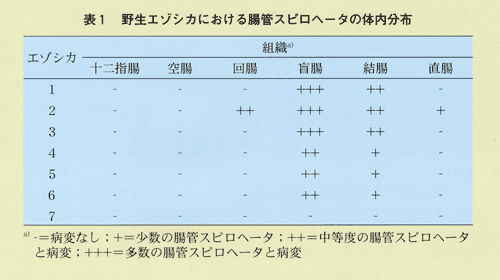
- 組織学的に、7頭中6頭の盲腸と結腸に、腸上皮細胞と杯細胞の過形成ならびにマクロファージとリンパ球の浸潤を伴う粘膜固有層の水腫を認めた (表1)。 多数の好銀性スピロヘータが陰窩に認められ、腸上皮細胞および杯細胞への侵入像もみられた。
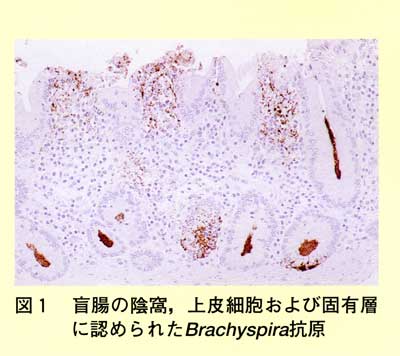
- 免疫組織学化学的に、抗B. hyodysenteriaeとB. pilosicoli血清を用いたSAB染色で、このスピロヘータは陽性を示した (図1)。
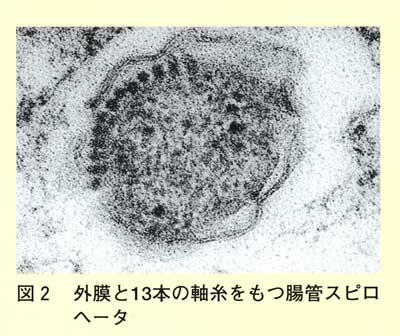
- 電子顕微鏡学的に、このスピロヘータは長さ6-14μm、幅0.2-0.3μm、4-6個のうねりおよび13本の軸糸をもち、Brachyspira spp.に類似していた (図2)。
- これら野生エゾシカの検索結果は、牛腸管スピロヘータ症のものと非常に類似していた。
- 以上の結果からBrachyspiraに属すると考えられる腸管スピロヘータがウシの赤痢と野生エゾシカの大腸炎に深く 関わっていることを示し、また、この腸管スピロヘータ症がすでに日本の野生エゾシカの間で拡がっていること、このスピロヘータによる消化管機能障害がウシ とエゾシカの新しい疾病となり、同一ないし類似のスピロヘータがウシとエゾシカを含む反芻動物に感染する可能性が示唆された。
|
| 成果の活用面・留意点 |
この成績は反芻動物の腸管スピロヘータ症の診断予防に活用できる。
|
| 図表1 |
 |
| 図表2 |
 |
| 図表3 |
 |
| カテゴリ |
シカ
|